Spec Sheet Fiction: How SSD Manufacturers Engineer Misleading Performance Numbers
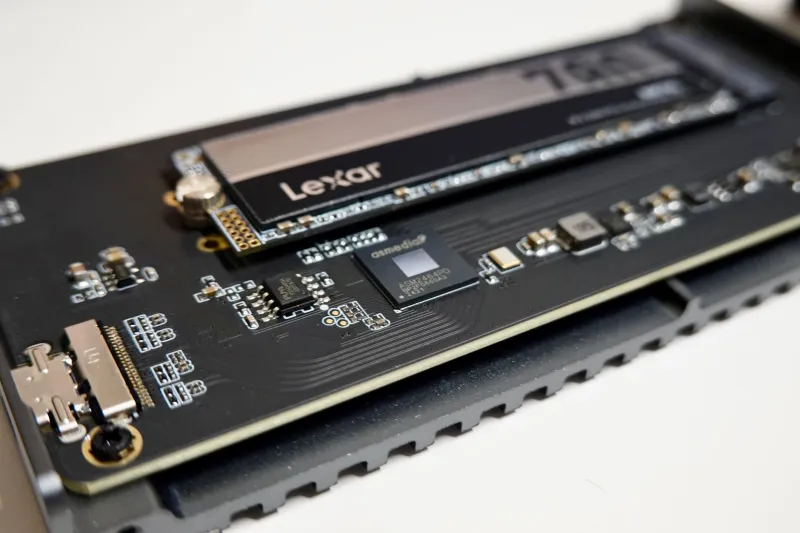
When a major storage manufacturer publishes sequential write speeds of 7,000 MB/s on a consumer NVMe drive, that number is not technically false. It is, however, profoundly incomplete. The conditions under which that figure was recorded bear almost no resemblance to the conditions under which you will actually use the drive. For serious buyers who depend on storage performance—whether for video production, data science workflows, or high-frequency file transfers—understanding the engineering behind that gap is not optional.
The Cache Illusion: How SLC Buffering Distorts Benchmark Results
Nearly every modern consumer SSD ships with a dynamic write cache that temporarily stores incoming data in SLC (single-level cell) mode, even when the underlying NAND is TLC (triple-level cell) or QLC (quad-level cell). SLC stores one bit per cell, which allows dramatically faster write operations. TLC stores three bits per cell, which increases density and reduces cost but writes significantly slower.
Manufacturers configure a portion of the NAND to behave as SLC temporarily. When you write data, the drive accepts it at SLC speeds. Once that cache is saturated—or once the drive's firmware determines it cannot sustain the buffer—writes begin landing directly on TLC or QLC cells at their native speeds, which can be 60 to 80 percent slower than the advertised figure.
The size of that SLC buffer varies by manufacturer and is rarely disclosed in standard spec sheets. On some budget-tier drives, the dynamic cache may be as small as 10 to 15 percent of total capacity. On a 2TB drive, that means sustained writes beyond roughly 200 to 300GB will drop to native NAND speeds. For users transferring large media files or working with virtual machines, this cliff is encountered regularly.
TLC vs. MLC: The Trade-Off That Marketing Conceals
MLC NAND, which stores two bits per cell, occupies a middle ground between the performance of SLC and the density economics of TLC. Drives built on MLC sustain higher write speeds over longer durations because there is no artificial cache layer masking a slower underlying medium. The problem is cost: MLC is substantially more expensive to manufacture, and most consumer-tier products have migrated almost entirely to TLC or QLC.
Enterprise-grade SSDs still rely heavily on MLC or even SLC NAND precisely because sustained write performance matters in server environments where sequential workloads run continuously. Consumer drives, by contrast, are benchmarked under burst conditions that favor cache-inflated numbers.
The practical consequence for a video editor copying a 500GB project between drives is significant. A TLC drive marketed at 5,000 MB/s sequential write may sustain that speed for the first 40 seconds of the transfer before dropping to 1,200 MB/s or lower. An MLC-based drive at a lower advertised peak may actually complete the same transfer faster because it never falls off the performance cliff.
Thermal Throttling: The Second Variable Manufacturers Ignore
Controller heat is the second major contributor to the gap between advertised and real-world speeds. NVMe controllers generate considerable heat under sustained load, and most consumer M.2 drives ship without heatsinks. When the controller reaches its thermal threshold—typically between 70°C and 85°C—the drive's firmware reduces operating frequency to protect the hardware.
This throttling behavior is rarely disclosed in specification documentation. Manufacturers test drives in open-air environments or under active cooling and publish results accordingly. In a compact desktop, laptop chassis, or NAS enclosure where airflow is restricted, the same drive may throttle within minutes of sustained operation.
Aftermarket heatsinks, available from several US-based vendors for under $15, can meaningfully delay the onset of throttling on drives installed in desktop systems. However, the more important step for a serious buyer is understanding whether thermal throttling is even occurring in their specific use case.
Testing Methodology: Exposing the Bottlenecks Before Purchase
Several free tools allow buyers to measure real-world SSD performance rather than relying on manufacturer data.
CrystalDiskMark provides the burst sequential figures most manufacturers cite. Run it, note the results, and then proceed to a sustained transfer test.
AS SSD Benchmark includes a compression benchmark that stresses the controller more aggressively and surfaces performance inconsistencies that CrystalDiskMark misses.
TxBENCH and manual large-file transfer tests are more revealing. Copy a folder of 50GB or larger from another drive and monitor transfer speed over time using Windows Task Manager's Performance tab. If the speed drops sharply after the first 20 to 30 seconds, the SLC cache has been exhausted.
HWiNFO64 monitors drive temperature in real time. Run a sustained write test and observe whether temperatures climb above 70°C. If they do, thermal throttling is likely affecting your results.
For buyers in the US market, third-party review sites that publish sustained write benchmarks—rather than burst figures alone—provide the most actionable pre-purchase data. Look specifically for tests that include full-drive write scenarios and thermal data.
What This Means for Your Purchase Decision
Not every buyer needs to worry about these limitations. For general desktop use, web browsing, and application loading, burst cache performance is entirely sufficient. The gap between a $60 TLC drive and a $200 MLC-based alternative is invisible in those scenarios.
The calculus changes substantially for professional workflows. Video editors working with RAW footage, data engineers running large ETL pipelines, and backup administrators moving multi-hundred-gigabyte archives should prioritize sustained write performance over peak sequential figures. For those buyers, the spec sheet is not a guide—it is a marketing document that requires independent verification.
Drive selection should begin with the question of how large your typical write operations are, not how impressive the advertised number looks on a retail listing.