Variable Refresh Rate Monitors: The Artifacts and Trade-Offs That Vendors Omit From the Spec Sheet
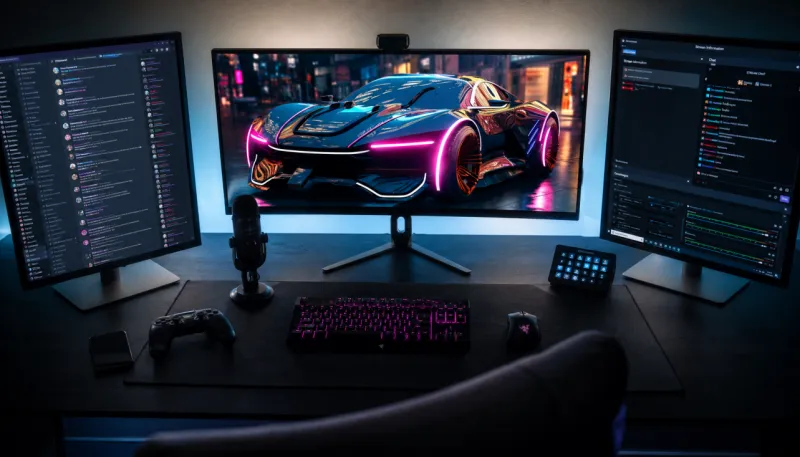
Photo: gaming monitor variable refresh rate display setup desk, via us.ktcplay.com
Variable refresh rate technology entered the mainstream monitor market with a straightforward value proposition: by synchronizing the display's refresh cycle to the GPU's output frame rate, VRR eliminates screen tearing and reduces stuttering without the input lag penalty associated with traditional V-Sync. That core proposition is technically sound. The problem is that it has been marketed as a comprehensive solution to display synchronization rather than what it actually represents—an engineering trade-off that introduces its own set of performance variables while resolving others.
For buyers currently evaluating G-Sync, FreeSync Premium, or HDMI 2.1 VRR-capable monitors, the relevant question is not whether VRR works, but whether its specific trade-offs are acceptable for their intended workload. That is a question the specification sheet is not designed to answer.
How VRR Actually Functions—and Where It Creates Problems
Fixed refresh rate displays operate on a consistent timing cycle. A 144Hz monitor refreshes 144 times per second regardless of GPU output, which is precisely what creates tearing when the GPU delivers frames at an inconsistent rate. VRR resolves this by making the display's refresh cycle responsive to frame delivery timing, holding a frame on screen until the next one is ready rather than refreshing on a fixed schedule.
This dynamic behavior is effective at its stated goal. However, the same mechanism that eliminates tearing introduces a secondary set of display behaviors that are not present in fixed refresh rate operation. Because the panel's backlight and pixel response systems are engineered for consistent timing, operating them at variable intervals creates conditions those systems were not optimized to handle.
The most widely documented consequence is brightness flickering, particularly at low frame rates. When frame delivery slows—as occurs during graphically demanding scenes—the extended interval between refreshes can cause perceptible luminance variation on certain panel types. OLED displays, which manage per-pixel luminance with high precision, are particularly susceptible to this behavior at the lower end of a monitor's VRR operating range. IPS and VA panels exhibit the effect to varying degrees depending on backlight control implementation.
NVIDIA's G-Sync module, which uses proprietary hardware to manage VRR behavior, incorporates a variable overdrive system designed to compensate for changing refresh intervals. This is a genuine engineering advantage. FreeSync implementations, which rely on the display panel's native scaler and do not include dedicated VRR hardware, vary considerably in how effectively they manage overdrive adjustment across the refresh rate range—a performance dimension that a FreeSync Premium certification does not fully capture.
The Low Frame Rate Compensation Problem
Every VRR implementation has a minimum operating threshold—the lowest refresh rate at which the synchronization mechanism remains active. Below this threshold, the display reverts to a fixed refresh behavior, typically by multiplying the delivered frame rate to stay within the VRR range. This behavior is called Low Frame Rate Compensation, or LFC.
LFC is a practical necessity, but it introduces its own artifact category. When a display transitions between LFC operation and standard VRR operation, the change in refresh behavior can produce a visible stutter or frame timing inconsistency. This transition artifact is most noticeable in games that regularly cross the LFC threshold—typically around 40-48Hz depending on the monitor's VRR floor—which includes many demanding titles running on mid-range GPU configurations common in the US consumer market.
Manufacturers specify VRR ranges (e.g., 48-144Hz) without addressing transition behavior at the boundary conditions. A monitor with a 48Hz VRR floor paired with a GPU that frequently delivers 45-52 fps in demanding scenarios will cycle through VRR and LFC modes repeatedly, producing a less stable visual experience than either a consistently high frame rate or a consistently low one.
Input Lag Variability Under VRR
Fixed refresh rate displays deliver consistent input lag—the interval between a user input and its visual representation on screen remains stable because the display's timing cycle is stable. VRR introduces a degree of input lag variability because the display's response to any given input depends on where in the current variable refresh cycle that input arrives.
In practice, this variability is small—typically measured in single-digit milliseconds—and falls below the perceptual threshold for most users. However, for competitive gaming applications where input lag consistency is a primary performance requirement, the variability introduced by VRR is a meaningful consideration. This is one reason why professional esports players and competitive gaming setups frequently favor fixed high refresh rate displays over VRR-enabled alternatives, even when the fixed rate monitor's peak refresh specification is lower.
G-Sync Ultimate certification includes requirements for input lag consistency that standard G-Sync Compatible (FreeSync-based) certifications do not mandate. This distinction is relevant for buyers whose use case involves latency-sensitive competitive gaming, but it is rarely explained in retail product comparisons.
Motion Clarity and VRR's Interaction With Backlight Strobing
Motion clarity—the sharpness of moving objects on screen—is primarily a function of pixel response time and backlight behavior. Many high refresh rate monitors incorporate backlight strobing (marketed as ULMB, ELMB, or similar branded terms) to reduce motion blur by briefly extinguishing the backlight between refreshes. This technique is effective at improving motion clarity but is fundamentally incompatible with VRR operation on most current implementations.
The result is a forced choice: a buyer can have VRR synchronization or backlight strobing for motion clarity, but not both simultaneously. For use cases where motion clarity is the primary performance requirement—fast-paced competitive gaming, sports simulation titles—a fixed high refresh rate monitor with backlight strobing capability may deliver a superior practical experience compared to a VRR monitor that cannot offer strobing during synchronized operation.
Some monitor manufacturers have begun developing hybrid implementations that allow limited strobing within VRR operation, but these remain early-generation solutions with their own artifact profiles and are not yet available across the mainstream market.
When VRR Delivers Genuine Value
None of the above analysis invalidates VRR as a technology. For specific use cases, its advantages are substantial and real. Single-player gaming with variable frame rate output—open-world titles, narrative games, or graphically demanding experiences where maintaining a locked frame rate is impractical—benefits meaningfully from VRR's elimination of tearing and reduction of stutter. The visual consistency improvement in this context is perceptible and valuable.
For console gaming via HDMI 2.1 VRR, where frame rate variability is inherent to the platform's performance characteristics, VRR support provides a genuine quality-of-life improvement over fixed refresh operation. The PS5 and Xbox Series X both support HDMI 2.1 VRR, making it a relevant feature for buyers who use monitors with console inputs.
For professional creative workflows where display synchronization affects review of motion content, VRR has limited relevance. These applications prioritize color accuracy, calibration stability, and consistent luminance—characteristics that VRR's dynamic refresh behavior can actively complicate.
A Framework for Evaluating VRR in Purchase Decisions
Buyers should approach VRR specifications with a use-case-first framework. Identify the primary workload the monitor will serve. Determine whether that workload involves the frame rate variability that VRR is designed to address. Evaluate whether the artifact trade-offs—brightness variability, LFC transition behavior, motion clarity limitations—are acceptable given that workload.
For buyers whose primary use is competitive gaming at consistently high frame rates, a fixed high refresh rate monitor without VRR overhead may represent a more targeted and cost-effective choice. For buyers managing variable frame rate single-player content, VRR's benefits are genuine—provided the implementation is evaluated beyond the certification badge.
The specification sheet identifies whether VRR is present. It does not identify whether VRR is appropriate. That determination requires the kind of analysis that this category of purchase consistently demands.