VA Is Not Watts: The UPS Specifications That Decide Whether Your NAS Shuts Down Cleanly or Not at All
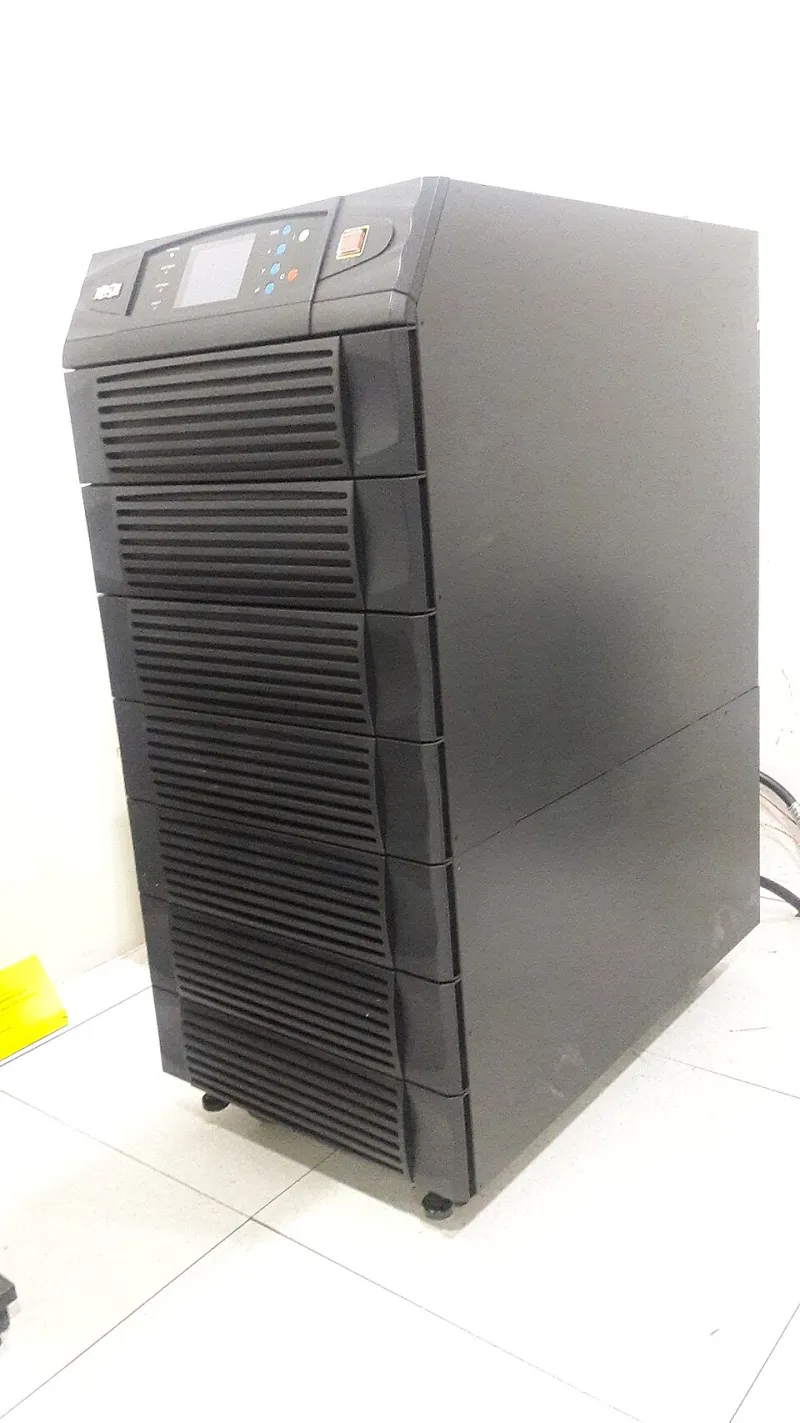
Photo: Tahir mq, CC BY-SA 4.0, via Wikimedia Commons
The uninterruptible power supply is the only component in a small rack that is expected to sit idle for two years and then perform flawlessly under the worst possible conditions. Most buyers select one on VA rating and price, install it, and never test it again. That approach works until the first outage, at which point the NAS either shuts down cleanly or loses a filesystem journal it needed.
VA is a ceiling, watts are the load
Volt-amperes measure apparent power; watts measure real power. The ratio between them is the power factor, and consumer UPS vendors quote the friendlier number. A 1500 VA unit rated at 900 W has a power factor of 0.6; a better-engineered 1500 VA unit may be rated at 1500 W. The two are not comparable, and the watt rating is the one that governs whether the load fits.
Equipment with active power factor correction presents a power factor near 1.0 to the UPS, which is generally favorable. Older or cheaper gear with a lower power factor can exhaust the VA ceiling before the watt ceiling, which is the failure mode the VA-first shopper never anticipates. Buy on watts, and treat VA as an upper bound.
Sizing the load honestly
Nameplate figures on a NAS power supply describe the maximum the unit can draw, frequently two to three times actual consumption. Measure instead. A plug-in power meter at the wall will give you idle draw, steady-state load, and the spin-up surge when eight drives accelerate simultaneously — typically 150 to 200 W above steady state for a few hundred milliseconds, less if the operating system staggers spin-up.
Include everything you would need to stay reachable and shut down in an orderly way: the router, the optical network terminal, the managed switch, and any PoE devices hanging off it. Then apply headroom. A 25 percent margin is the minimum for a fixed load; 40 percent is reasonable for a system that will grow.
Finally, read the runtime curve at your calculated load, not at the 50 percent figure vendors highlight. Runtime falls off non-linearly, and a unit that delivers 12 minutes at half load may deliver four at full load — enough for a clean shutdown, not enough for an extended brownout.
Transfer time and the power supply's hold-up window
A line-interactive UPS transfers to battery in roughly 4 to 10 milliseconds. The ATX specification asks power supplies to hold output for around 17 milliseconds at full load, and quality units with adequately sized bulk capacitors and well-designed PFC stages do. Marginal supplies may not, and the symptom is a machine that reboots during an outage the UPS was supposed to cover.
Online double-conversion units transfer in zero milliseconds because the load never touches utility power directly. The cost is efficiency, heat, and fan noise. For a NAS with a competent power supply, a line-interactive unit with pure sine output is usually the correct balance; for laboratory or medical equipment, online is the defensible choice.
Simulated sine versus pure sine
A stepped approximation of a sine wave is adequate for a resistive load and problematic for an active PFC supply. Symptoms range from audible buzzing to the supply tripping offline on transfer, to a supply that refuses to restart until the UPS is power-cycled. Some UPSs also misread the connected load and report overload on a supply that is well within the watt rating.
If the equipment behind the UPS costs more than the UPS does, buy sine wave output. It is not a premium feature; it is the baseline for modern switching supplies.
The signaling chain is the part that actually saves the array
A UPS with a USB port is not the same as a UPS that successfully communicates with your NAS. The relevant standard is the USB HID Power Device class, which delivers On Battery and Low Battery events to the host. Whether the host acts on them depends on the agent software.
Synology and QNAP both maintain compatibility lists; check your exact model before purchase. Where native support is thin, Network UPS Tools (NUT) is the reliable fallback and can run in server mode on the NAS, with other hosts configured as clients so a single USB connection shuts down the entire rack in the correct order.
Then test it. Pull the plug and watch the logs. If the NAS does not record an On Battery event within a second or two, the signaling is broken regardless of how well the transfer worked. Also review the shutdown delay and low-battery threshold; a default that triggers shutdown at 20 percent remaining runtime may leave too little margin for a large array to flush caches and unmount cleanly.
The date code nobody checks
Sealed lead-acid batteries are consumable. Design life is three to five years at 25 degrees Celsius, and every additional 8 to 10 degrees above that roughly halves it. A UPS in a garage in Phoenix has a very different service life than one in a conditioned closet in Minneapolis.
Look for a hot-stamped or printed date on the battery itself, often in YYMM form or a coded string the manufacturer can decode. If a unit sat in a warehouse for eighteen months before you bought it, you paid new price for a partially consumed battery. Record the install date on the chassis so the next replacement decision is not guesswork.
A pre-purchase checklist
- Watt rating, not VA rating, comfortably above measured peak load with 25 to 40 percent headroom.
- Pure sine wave output for any load with active PFC.
- Transfer time stated in milliseconds and appropriate to the power supplies in use.
- USB HID signaling confirmed against the NAS vendor's compatibility list, or NUT support verified.
- Battery date code visible on the unit or disclosed by the seller.
- Runtime curve available at your calculated load, not only at 50 percent.
- Replaceable battery with a current part number in stock.
A test routine worth following
Run the self-test monthly and confirm it appears in the log rather than assuming it passed. Once a quarter, pull utility power under real load and measure runtime to the low-battery event; a 20 percent drop from the previous measurement is a replacement signal. Annually, inspect the battery for swelling and corrosion, verify the date code, and update the runtime record.
The UPS is not a accessory. It is the component that determines whether an outage costs you a few minutes of uptime or a weekend of recovery. Size it on watts, specify it on waveform and signaling, and test it on a schedule.